
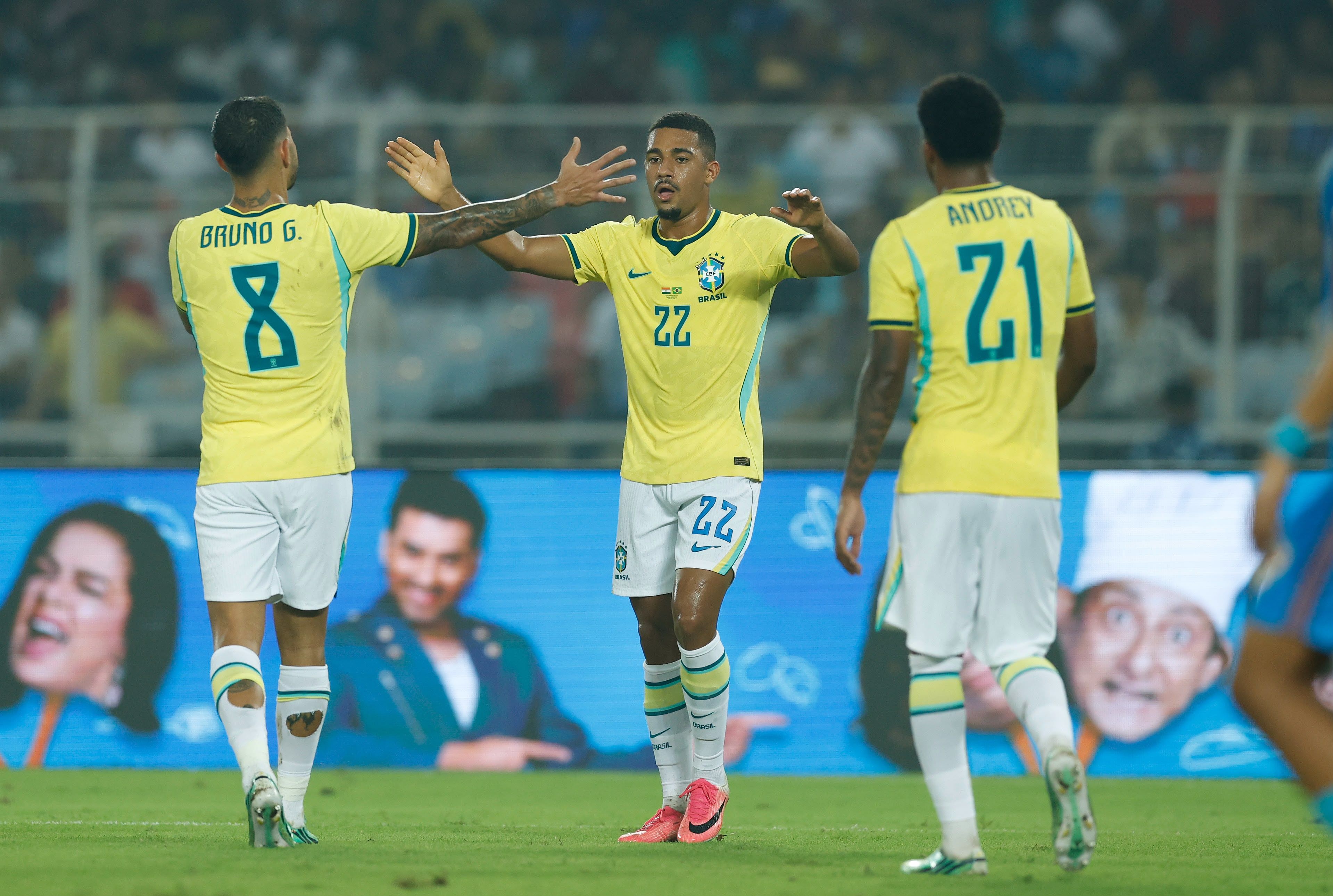
Brazil completed their October international window with a convincing 4-0 win over India in Kolkata, a historic first senior meeting between the two countries. The five-time world champions were made to wait for the breakthrough, but once Estêvão opened the scoring in the 28th minute, Brazil gradually took control of the contest.
Pedro doubled the lead shortly before half-time, giving Brazil a 2-0 advantage at the interval. Samuel Lino then made the result emphatic after the break, scoring in the 58th minute and adding another goal deep into stoppage time to complete his brace.
The scoreline reflected Brazil's greater quality, but India had useful periods before the visitors pulled away. The All India Football Federation reported that the hosts held their shape well during the opening stages and made Brazil work for space, while also creating an early moment of danger from a corner. Reuters likewise noted that India initially frustrated Brazil before the visitors' attacking quality became decisive.
A landmark fixture for India
Beyond the result, the occasion carried significance for Indian football. It was the first senior international meeting between India and Brazil, bringing one of world football's most recognisable national teams to the Vivekananda Yuba Bharati Krirangan in Kolkata.
The match also gave India an unusually demanding test against elite opposition. Brazil arrived in India after two friendlies against Australia, drawing 1-1 in Townsville before winning 4-2 in Brisbane. Their victory in Kolkata therefore completed the three-match window with two wins and a draw.
For India, the value of the game lies less in the final score than in what can be taken from competing against a side with Brazil's depth and technical level. The opening phase showed that India could remain organised and competitive for stretches, but Brazil's ability to convert pressure into goals exposed the difference in execution once the match opened up.
Brazil spread the goals
One of the notable features of the win was that Brazil did not rely on a single established star for the scoreline. Estêvão started the scoring, Pedro added the second and Samuel Lino came from the bench to score twice. The Brazilian Football Confederation highlighted Lino's brace after the match, while also confirming that the victory rounded off the team's extended international window.
Brazil coach Carlo Ancelotti had used the Australia and India fixtures to look at different combinations and players. That wider context made the India friendly more than a one-off exhibition: it formed part of Brazil's continuing preparation after the 2026 World Cup.
What happens next
Brazil's next scheduled internationals are in November, with the CBF listing matches against Japan on 14 November and Singapore on 17 November, both in Singapore. For India, the immediate task is to absorb the lessons from a rare meeting with top-level opposition and carry the positive elements from the opening stages into their next fixtures.
For South African readers, the match was also notable for the level of online interest around the India-Brazil pairing. The result itself was clear-cut, but the wider interest came from the novelty of the fixture, Brazil's global pull and the chance to see India tested against one of football's traditional powers.